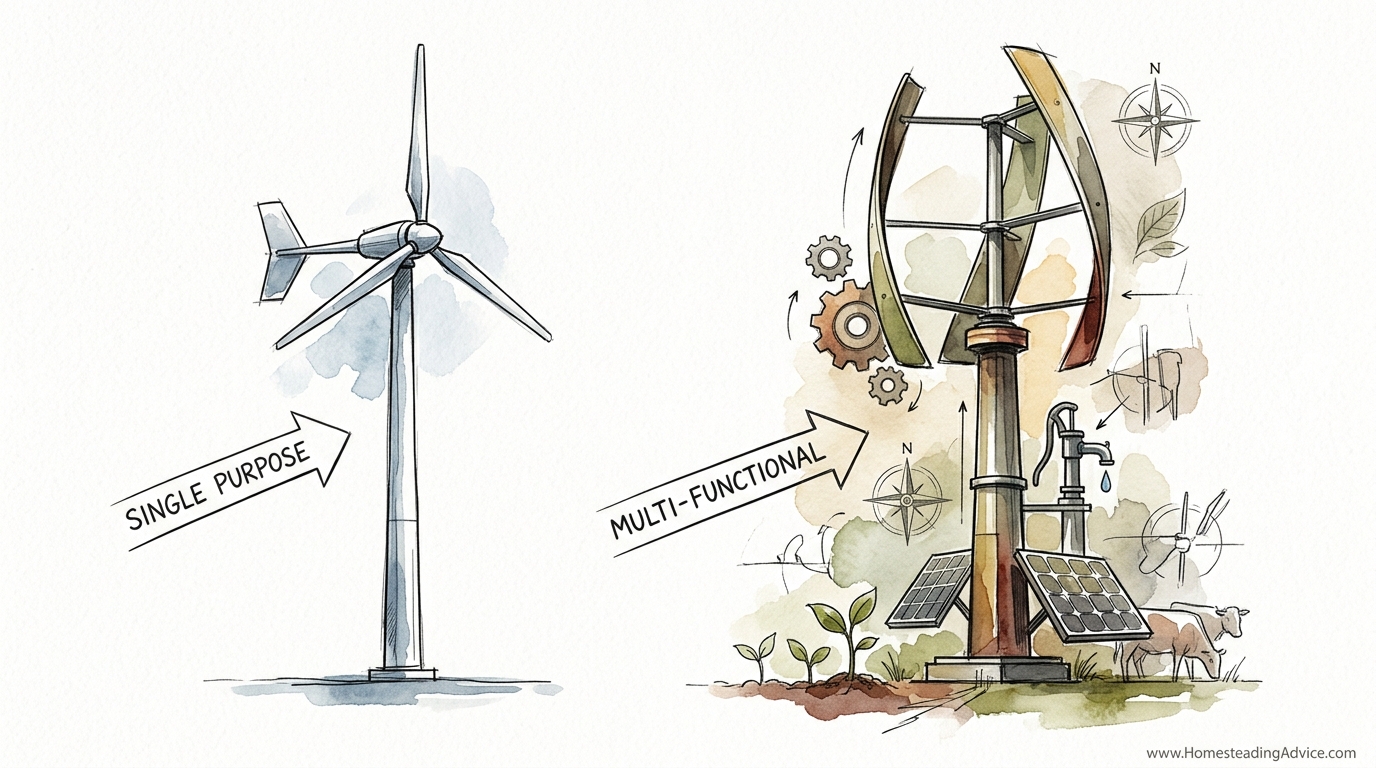
Why settle for a simple battery charger when the wind can run your entire farm’s infrastructure simultaneously? Most people install a turbine just to charge a phone or a single light. A master homesteader makes the wind pump their water, aerate their fish pond, and power their workshop all at once. Stop wasting the vertical space and start integrating your energy systems.
Harnessing the wind is an ancient craft, yet we often approach it with a modern, narrow focus. We think in terms of wires and watts, forgetting that the wind is a source of raw kinetic force. Our ancestors understood this better than we do; they didn’t just want electricity—they wanted work done. They built machines that could grind grain while the family slept or draw water from deep aquifers when the breeze was barely a whisper.
Today, a multi-functional approach to wind power isn’t just about being “green.” It is about resilience and independence. By diversifying what your turbine does, you reduce the strain on your battery bank and ensure that even if your electrical components fail, your mechanical systems—like water pumping—continue to function. It is the difference between a farm that breaks when a fuse blows and a homestead that thrives because its core systems are tied directly to the pulse of the land.
Multi-Functional Wind Turbine Guide
A multi-functional wind turbine is a system designed to perform more than one primary task using the same rotational energy captured by the wind. While a standard residential turbine typically spins an alternator to create electricity, a multi-functional system uses mechanical linkages, air compressors, or secondary drives to accomplish multiple goals at once. Think of it as the “Swiss Army Knife” of the sky.
Historically, the American-style farm windmill was the king of multi-functionality. Companies like Aermotor and Dempster built millions of these machines across the Great Plains starting in the mid-19th century. By 1930, more than 600,000 wind pumps were in operation across the United States. These weren’t just for water; they were the heartbeat of the farm, providing the force needed for laundry, irrigation, and livestock care. Many of these sturdy machines are still spinning today, a testament to the longevity of simple, mechanical designs that prioritize grit over gadgets.
In a modern context, these systems are used where high reliability is needed. You might find a vertical-axis helical turbine—a design often favored by the Amish for its simplicity—running a milk cooler or a workshop lathe without a single connection to the public utility grid. Because these machines can start spinning in winds as low as 6.5 kilometers per hour (4 miles per hour), they provide a consistent, low-torque output that is perfect for continuous tasks like pond aeration or trickle-charging a 24-volt battery bank.
How to Integrate Multi-Functional Systems
Integrating multiple functions into a single turbine requires a clear understanding of torque and rotational speed. Most electricity generation requires high-speed rotation (RPM), while mechanical tasks like pumping water require high torque at lower speeds. To bridge this gap, homesteaders use several different techniques to split the power.
The Mechanical Power Take-Off (PTO)
Just like a tractor has a PTO to run implements, a multi-functional wind turbine can use a drive shaft or belt system to move power from the hub to the ground. This is often achieved using a “gear-head” design at the top of the tower. A set of bevel gears turns the horizontal rotation of the blades into a vertical rotation down the center of the tower. At the base, a clutch or belt-tensioner allows you to engage different machines, such as a grain mill or a mechanical water pump.
Air Compression and Aeration
One of the most efficient ways to use a wind turbine multi-functionally is through air compression. Instead of (or in addition to) an alternator, the turbine drives a small piston or diaphragm compressor. This compressed air can be sent through 12.7-millimeter (1/2-inch) poly tubing to a pond up to 300 meters (1,000 feet) away. This air serves two purposes: it aerates the water to keep fish healthy and prevents ice from forming in the winter. Excess compressed air can even be stored in a tank to run pneumatic tools in the shop later.
Dual-Output Hubs
Advanced homesteaders sometimes build turbines with dual outputs. The main shaft drives a permanent magnet generator (PMG) for electricity, while a secondary chain-drive runs a slow-speed water pump. This requires a turbine with a larger rotor diameter—often 3 to 5 meters (10 to 16 feet)—to ensure there is enough surface area to capture the extra energy needed for both loads. When the wind is light, the electrical system might be bypassed so all available torque goes to the water pump.
Benefits of Multi-Functional Wind Energy
The primary advantage of a multi-functional system is energy efficiency. Every time you convert energy—from wind to electricity, then from electricity to a motor’s movement—you lose power to heat and friction. By using the wind’s mechanical force directly to pump water or grind grain, you bypass the middleman, often achieving 20% to 30% higher efficiency than an all-electric equivalent.
Reliability is another cornerstone of this approach. Electronic components, like inverters and charge controllers, are often the first things to fail during a lightning storm or a surge. A mechanical linkage or a simple air pump is far more robust. If your batteries die, your pond still breathes and your livestock still drink because the wind is moving the hardware directly. This is the definition of “pioneer-grit” engineering—building systems that don’t need a technician to fix.
Finally, these systems provide a smaller footprint. Instead of having a tower for your electricity, a separate windmill for your well, and a solar-powered aerator for your pond, you consolidate your infrastructure into one well-placed tower. This saves on material costs, maintenance time, and land use, allowing you to keep your fields clear for crops or grazing.
Challenges and Common Mistakes
One of the most frequent errors is a torque mismatch. Beginners often try to attach a high-resistance load, like a heavy water pump, to a turbine designed for high-speed electricity. The result is a turbine that refuses to start in anything less than a gale. To avoid this, use a gearbox with a ratio of at least 3:1 or 4:1 if you are performing mechanical work. This trade-off—giving up speed for power—is essential for multi-functional success.
Braking and overspeed protection are often overlooked in DIY multi-functional setups. When a turbine is performing multiple tasks, the load on the blades can change suddenly—for instance, if a pump run dry or a belt snaps. Without a mechanical brake or a “furling” system (which turns the blades out of the wind), the turbine can spin out of control and disintegrate. Always install a manual friction brake at the base of the tower and an automatic centrifugal governor on the hub.
Maintenance is also more complex. While a standard turbine has few moving parts, a multi-functional system involves belts, chains, gears, and valves. Neglecting lubrication is a death sentence for these machines. In a harsh environment, grease can dry out or become contaminated with dust. Plan for a monthly “climb and lube” schedule or, better yet, design your system with ground-level maintenance points using long-run grease lines.
Limitations and Constraints
Multi-functional wind turbines are not a “set it and forget it” solution. They require a user who is comfortable with a wrench and understands basic mechanics. If you are looking for a system that requires zero interaction, a simple solar array is likely a better fit. Wind power is for the tinkerer, the person who enjoys tuning a machine to match the seasons.
Environmental constraints also play a major role. Wind is fickle; it doesn’t blow at a constant speed, and it doesn’t always blow when you need the work done. For example, if you rely solely on wind for water pumping, you must have enough storage—such as a 3,800-liter (1,000-gallon) tank—to last through 3 to 5 days of calm weather. Vertical space is also a requirement. To get clean, non-turbulent air, your turbine must be at least 9 meters (30 feet) higher than any obstacle within 90 meters (300 feet). If your homestead is in a dense forest or a deep valley, the wind may not have the “clean” force required to run multiple systems.
Single-Purpose vs. Multi-Functional Systems
To help you decide which path is right for your homestead, consider the following comparison based on a typical 1.5 kW output potential.
| Factor | Single-Purpose (Electric) | Multi-Functional (Integrated) |
|---|---|---|
| Complexity | Low (Wires and Inverters) | High (Mechanical Linkages) |
| Efficiency | Medium (Losses in conversion) | High (Direct mechanical work) |
| Maintenance | Occasional (Electronics) | Frequent (Moving parts) |
| Startup Wind | 9-12 km/h (6-8 mph) | 6-8 km/h (4-5 mph) |
| Resilience | Dependent on Battery/Inverter | Independent Mechanical Backup |
| Cost | Lower Initial Cost | Higher Initial Engineering |
Practical Tips and Best Practices
When siting your multi-functional turbine, don’t just look for the highest point. Look for the “throat” of the wind—areas where the terrain funnels the air, increasing its velocity. A 10% increase in wind speed results in a nearly 30% increase in available power. If you can find a natural wind corridor on your property, that is where your tower belongs.
- Use a Guyed Tower: For multi-functional systems that produce high vibrations (like piston pumps), a guyed tower is often superior to a free-standing one. The cables help dampen the mechanical pulses that could otherwise fatigue the metal tower over time.
- Oversize Your Storage: Whether it is a battery bank for electricity or a cistern for water, always plan for the worst-case scenario. In most regions, a 48-hour reserve is the bare minimum; 72 to 120 hours is much safer.
- Monitor Your Bearings: Heat is the first sign of trouble. If you can, install a simple remote thermometer on the main hub bearing. A sudden spike in temperature tells you that a bearing is failing long before it seizes up.
- Choose the Right Blade: For multi-functional work, high-solidity rotors (blades with more surface area) are better. They catch more wind at low speeds, providing the torque needed to start a pump, even if they don’t spin as fast as thin, three-blade electricity turbines.
Advanced Considerations for the Master Homesteader
Once you have mastered basic integration, you can look into Thermal Dump Loads. When your batteries are full and your water tank is overflowing, a wind turbine still has energy to give. Instead of braking the turbine and wasting that potential, you can divert the excess electricity into a resistive heating element in your hot water tank or a thermal mass (like a large stone bench) in your greenhouse. This turns “wasted” wind into free heat for your home.
Another advanced technique is the use of Micro-Grid Synchronization. If you have both wind and solar, don’t just run them into the same battery. Use a smart controller that prioritizes the wind for mechanical tasks during the night (when solar is offline) and uses solar for the bulk of the electrical charging during the day. This balanced approach extends the life of your batteries by reducing the depth of discharge during the dark hours.
A Scenario in Practice: The Integrated Orchard
Imagine a 2-hectare (5-acre) cider orchard. The owner installs a 3.6-meter (12-foot) diameter turbine on a 15-meter (50-foot) tower. During the day, the turbine spins a 2 kW alternator, providing enough power to run the electric cider press and charge the farm’s utility vehicle.
Simultaneously, a small belt-driven compressor on the turbine shaft sends air down to a pond at the edge of the orchard. This keeps the water clear for irrigation. In the evening, when the electrical demand drops, the owner engages a mechanical lever at the base of the tower. This shifts the turbine’s torque to a piston pump that draws 15 liters (4 gallons) of water per minute from a 30-meter (100-foot) well, filling an elevated storage tank for the next day’s gravity-fed irrigation. One machine, three distinct farm functions, zero fuel costs.
Final Thoughts
The wind is more than just a source of electricity; it is a tireless farmhand waiting to be put to work. By moving beyond the single-purpose mindset, you unlock the true potential of your homestead’s vertical space. Integrating mechanical pumping, air compression, and electrical generation into one system isn’t just an engineering feat—it is an act of self-reliance that honors the wisdom of those who settled the land long before us.
Start small if you must. Begin with a turbine for charging, then look for ways to add an air line or a mechanical linkage. As you learn the language of the wind on your specific piece of land, you will find more “chores” that the breeze is happy to handle. The goal is a homestead that works in harmony with the elements, where every gust of wind contributes to the fertility and functionality of your farm.
Embrace the complexity and the occasional grease under your fingernails. The rewards—lower bills, higher resilience, and the quiet satisfaction of a well-oiled machine—are worth every bit of the effort. The wind is blowing; make sure it is doing more than just spinning a fan.