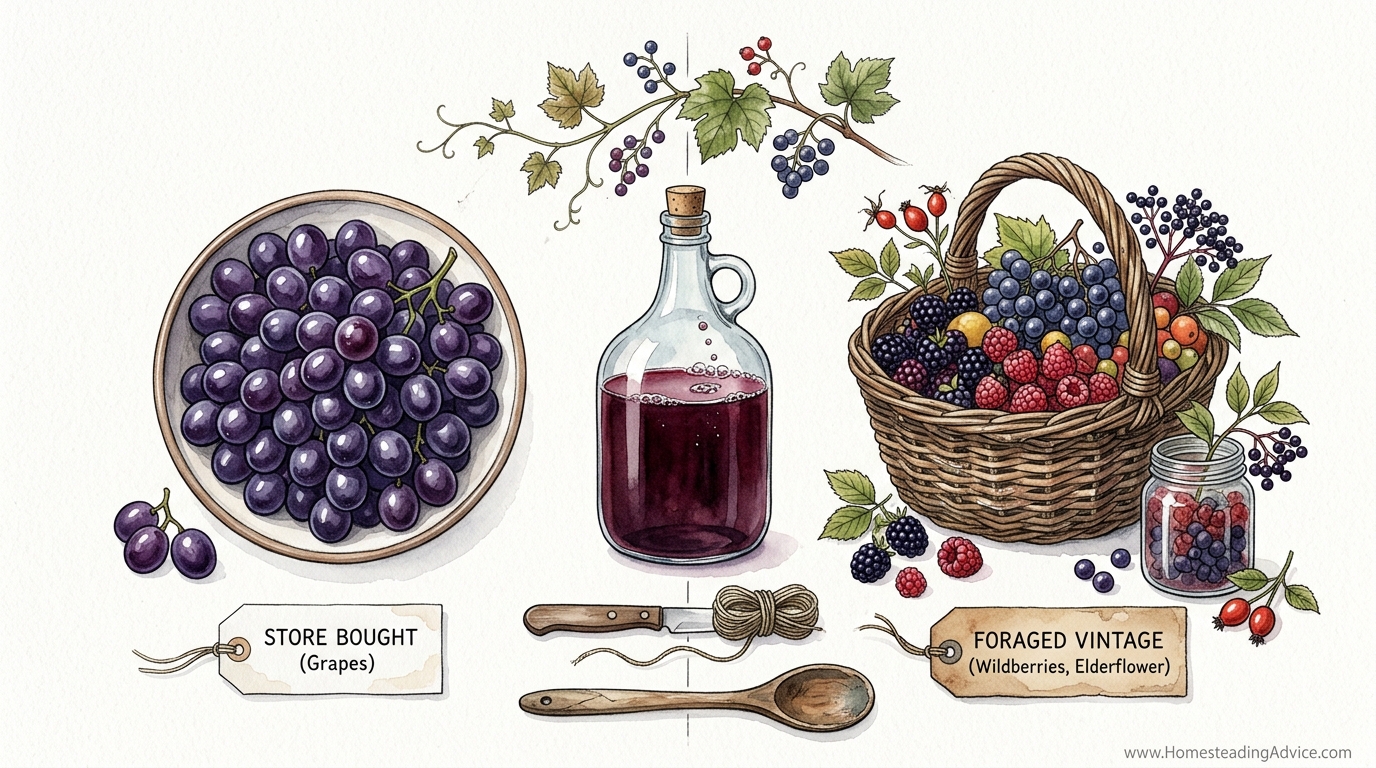
You can’t make a ‘Grand Cru’ out of a cardboard box; the secret to elite wine is found in the hedgerow, not the grocery aisle. Store-bought juice is pasteurized and stripped of the very tannins and wild yeasts that create complex wine. Professional results start with high-brix, foraged fruit that carries the terroir of your own land. Here is how to spot the difference before you start your next batch.
The Philosophy of Foraged Winemaking
Foraging for your winemaking ingredients connects you to the rhythm of the seasons in a way that no supermarket run ever could. When you walk the fence lines or scout the riverbanks, you are looking for the concentrated essence of your local environment. These wild fruits have spent the year fighting the elements, building up the polyphenols and sugars that give foraged wine its backbone.
Store-bought produce is bred for shelf life, uniform color, and transportability. These traits are often the enemies of fine winemaking, as they favor water weight over flavor density. Wild fruit, on the other hand, is usually smaller, more intense, and packed with the natural acids needed to preserve the vintage through the aging process.
Every bottle of foraged wine is a liquid record of a specific place and time. A dry summer will yield smaller, sweeter berries with a higher brix (sugar content), while a wet spring might result in a more delicate, floral profile. This variability is not a flaw; it is the soul of the craft, and it is why foraged vintages often outperform commercial equivalents in blind tastings.
Best Fruit For Homemade Wine
Selecting the right fruit is the most critical decision in the entire winemaking process. Not every berry that grows wild is suitable for a high-quality vintage, so you must learn to identify the champions of the hedgerow. The “Big Three” of wild winemaking are generally considered to be Elderberries, Blackberries, and Wild Grapes.
Elderberries (Sambucus nigra) are often called the “King of Country Wines” because they possess a chemical profile remarkably similar to commercial wine grapes. They are high in tannins and deep pigments, providing a robust body and a rich, dark color that mimics a heavy Cabernet. Wild elderberries typically show a brix level around 10.5 to 11.0, though some variations can reach higher depending on the region and soil quality.
Blackberries (Rubus fruticosus) are the workhorse of the home cellar, offering a deep, jammy flavor and excellent acidity. While they have lower tannin levels than elderberries, they provide a “mouthfeel” that is incredibly satisfying. Foragers should look for berries that are fully black and slightly soft to the touch, as under-ripe blackberries can introduce harsh, vegetal notes into the must.
Wild Grapes (Vitis riparia or Vitis labrusca) are the true ancestors of the modern wine industry. These grapes are often much more acidic than their cultivated cousins, sometimes requiring a “cold stabilization” process to drop out excess tartaric acid. However, their flavor is concentrated and carries a “foxy” or musky character that is highly prized by those seeking an authentic, rustic vintage.
Crabapples (Malus spp.) are frequently overlooked but serve as a vital tool for the winemaker. High in both malic acid and tannins, crabapples are rarely used as a standalone wine because they can be overwhelmingly astringent. Instead, they are used as an “anchor,” blended into softer fruit wines at a rate of 5% to 15% to provide structure and aging potential.
How the Foraged Must Works
The “must” is the raw mixture of crushed fruit, juice, and skins that eventually becomes wine. When working with foraged fruit, the process begins the moment you pick the berries. Unlike store-bought fruit, wild berries carry a “bloom”—a dusty white coating on the skin that is actually a colony of wild yeast (Saccharomyces cerevisiae and various non-Saccharomyces species).
Once you have harvested your fruit, usually aiming for 3 to 5 pounds per gallon (1.4 to 2.3 kg per 3.8 liters), you must crush them to release the juice. It is important to avoid crushing the seeds, especially in elderberries and grapes, as this can release bitter oils that ruin the flavor. A gentle mashing with a sanitized timber bat or a stainless steel potato masher is usually sufficient.
For red or dark fruit wines, you ferment “on the skins.” This means the fruit pulp remains in the liquid for the first 5 to 7 days of fermentation. This period, known as primary fermentation, is where the alcohol extracts the tannins and pigments from the skins. Without this step, your wine will be thin, pale, and lacking the complex structure required for long-term aging.
Adjusting the Chemistry
Because wild fruit varies so much, you must be prepared to adjust the must to ensure a successful fermentation. Professional winemakers use three primary measurements: Brix (sugar), pH (acidity), and TA (Titratable Acidity). Most foraged fruit will require the addition of granulated sugar to reach a target brix of 22 to 24, which results in a finished alcohol content of roughly 12% to 13.5%.
Acidity is the second pillar of a stable wine. A pH between 3.3 and 3.5 is the “sweet spot” for most red fruit wines. If the must is too alkaline (high pH), the wine will be prone to bacterial infection and will taste “flabby.” If it is too acidic (low pH), the yeast may struggle to ferment, and the finished product will be unpleasantly tart. You can raise the pH by adding calcium carbonate or lower it by adding a tartaric acid blend.
Benefits of the Foraged Approach
The primary benefit of using foraged fruit is the sheer depth of flavor. Commercial juices are often diluted or “balanced” to a generic standard, whereas foraged fruit retains its unique chemical fingerprints. You are getting 100% of the polyphenols and antioxidants that the plant produced to protect itself in the wild.
Cost is another significant advantage. While professional winemaking equipment requires an initial investment, the raw ingredients for foraged wine are entirely free. A single afternoon of picking can yield enough fruit for 5 gallons (19 liters) of wine, which would cost hundreds of dollars if purchased as high-end commercial bottles.
Self-reliance and the preservation of ancestral wisdom are also key factors. Knowing how to turn a wild harvest into a shelf-stable, calorie-dense, and medicinal beverage is a skill that has been passed down for generations. It transforms you from a consumer into a producer, giving you a sense of agency over your own pantry and cellar.
Challenges and Common Mistakes
One of the most frequent errors made by beginners is picking fruit that is not fully ripe. In the case of elderberries, unripe fruit contains cyanogenic glycosides, which can cause digestive upset. You must wait until the entire cluster is dark purple or black, with no green stems visible between the berries. If the birds aren’t eating them yet, they probably aren’t ready for you either.
Sanitation is the next major hurdle. While we value wild yeasts, we must also guard against “bad” bacteria and acetic acid-producing organisms. Every piece of equipment—from the primary fermenter to the smallest spoon—must be sanitized using a food-grade solution like Star San or potassium metabisulfite. Failure to do so will result in your hard-earned wine turning into high-priced vinegar.
Oxidation is the “silent killer” of homemade wine. During primary fermentation, the carbon dioxide produced by the yeast protects the wine. However, once the bubbling slows down, you must transfer the wine to a secondary vessel (a carboy or demijohn) with minimal headspace. Exposing the wine to air for too long will strip it of its vibrant color and leave it tasting like wet cardboard.
Limitations of Foraging
Foraging is entirely dependent on the whims of nature. A late frost can wipe out the elderberry blossoms, or a prolonged drought can cause blackberries to shrivel on the vine before they reach maturity. This means you cannot always count on making the same type of wine every year. You must be flexible and take what the land gives you.
Scale is another limitation. Picking enough wild grapes for a 50-gallon (190-liter) barrel is a massive undertaking that requires multiple people and many days of labor. Most foraged winemaking is best suited for small batches—typically 1 to 6 gallons (3.8 to 23 liters)—where you can maintain tight control over the quality of each individual berry.
Regional availability also dictates what you can create. If you live in a coastal area, you may have an abundance of rosehips and sea buckthorn. If you are in the mountains, you might be limited to crabapples and wild cherries. You cannot force a “terroir” that doesn’t exist; you must learn the specific flora of your own biome.
STORE BOUGHT vs FORAGED VINTAGE
The differences between these two approaches are measurable and noticeable. While store-bought juice is convenient, it often lacks the complexity required for a serious hobbyist. The following table highlights the key differences in the raw must.
| Feature | Store-Bought Juice | Foraged Wild Fruit |
|---|---|---|
| Wild Yeast | None (Pasteurized) | Present on Skins (The Bloom) |
| Tannin Content | Low to Moderate | High (Skin Contact) |
| Flavor Profile | Uniform and Sweet | Complex, Earthy, Acidic |
| Brix Levels | 12-16 (Standardized) | 5-20 (Variable by Season) |
| Processing | Minimal (Pour and Pitch) | Labor Intensive (Pick and Crush) |
Practical Tips for Success
Always use a hydrometer to measure your specific gravity (SG). This simple glass tool tells you exactly how much sugar is in your must. For a standard 12% wine, you want an initial SG of 1.090. If your foraged fruit only provides 1.045, you know exactly how much sugar you need to add to reach your goal.
Consider the “double-run” method for expensive or labor-intensive fruit. After you press the juice out of your first batch of elderberries, you can add water and more sugar to the leftover skins and pulp. This creates a “second run” wine that is lighter in body—more like a rosé—but still carries the beautiful aromatics of the original harvest.
- Keep a Logbook: Record the date, location of the forage, weather conditions, and initial chemistry readings. This is the only way to replicate a “legendary” batch.
- Temperature Control: Aim for a steady fermentation temperature between 65°F and 75°F (18°C to 24°C). If it gets too hot, the yeast produces “fusel alcohols” that taste like kerosene.
- Pectic Enzyme: Always add pectic enzyme to your foraged must. Wild fruit is high in pectin, which can cause a “pectic haze” that prevents the wine from ever becoming clear.
- Freezing Fruit: If you cannot pick enough fruit in one day, freeze your harvest in vacuum-sealed bags. Freezing actually helps break down the cell walls of the fruit, making juice extraction easier.
Advanced Considerations for the Serious Vintner
Experienced winemakers often look toward Malolactic Fermentation (MLF). This is a secondary process where specific bacteria (Oenococcus oeni) convert harsh malic acid—common in crabapples and wild grapes—into softer, creamy lactic acid. This process is what gives high-end Chardonnays their buttery mouthfeel and helps “round off” the sharp edges of a rustic foraged wine.
Oak aging is another way to elevate foraged fruit. Since we aren’t using expensive barrels for 1-gallon batches, you can use toasted oak chips or spirals. Adding 7 grams of medium-toast French oak per gallon (3.8 liters) for two to four weeks can introduce notes of vanilla, spice, and smoke that complement the dark fruit flavors of elderberries and blackberries.
Cold stabilization is a technique used for high-acid wild grapes. After the wine is finished and cleared, you place the carboy in a very cold environment (just above freezing) for two to three weeks. This causes excess tartaric acid to crystallize and fall to the bottom as “wine diamonds.” You then rack the clear wine off these crystals, resulting in a much smoother, more balanced beverage.
Example Scenario: The Wild Elderberry Vintage
Imagine it is late summer. You have harvested 15 pounds (6.8 kg) of prime, dark elderberries from a south-facing hedge. After destemming and a gentle crush, you have roughly 2 gallons (7.6 liters) of pure juice. You test the brix and find it is 10.5, with a pH of 4.1.
To turn this into a professional-grade wine, you first add 1.5 grams per liter of tartaric acid to bring the pH down to a stable 3.5. You then calculate that you need to add roughly 4 pounds (1.8 kg) of sugar to reach a specific gravity of 1.090. You decide to use a “spontaneous fermentation” by relying on the wild yeast bloom on the skins.
For the first five days, you stir the “cap” (the floating fruit solids) three times a day to prevent mold and ensure maximum color extraction. Once the gravity drops to 1.010, you press the solids and move the liquid to a glass carboy with an airlock. Six months later, after three rackings to remove the sediment (lees), you have a deep, complex red wine that rivals a store-bought Syrah, all for the cost of a few pounds of sugar.
Final Thoughts
Mastering the art of foraged winemaking is a journey into the heart of your local landscape. It requires patience, keen observation, and a willingness to work with the materials nature provides. By moving away from standardized store-bought juices and embracing the wild variability of the hedgerow, you unlock a level of quality and complexity that is simply unavailable to the casual consumer.
The transition from a grocery-aisle hobbyist to a foraged-vintage practitioner is one of the most rewarding steps a home winemaker can take. It instills a deep respect for the seasons and a practical understanding of food chemistry that serves as a foundation for all other forms of preservation. Whether you are starting with a handful of dandelions or a bucket of wild grapes, the principles remain the same: start with quality, respect the yeast, and let time do the heavy lifting.
As you build your cellar, you will find that these bottles become more than just a drink; they are memories of walks in the woods, hot afternoons by the river, and the satisfaction of a harvest well-earned. Experiment with different blends, try wild ferments, and don’t be afraid to let a bottle age for a year or two. The best glass of wine you will ever drink is likely still hanging on a branch somewhere, waiting for you to find it.