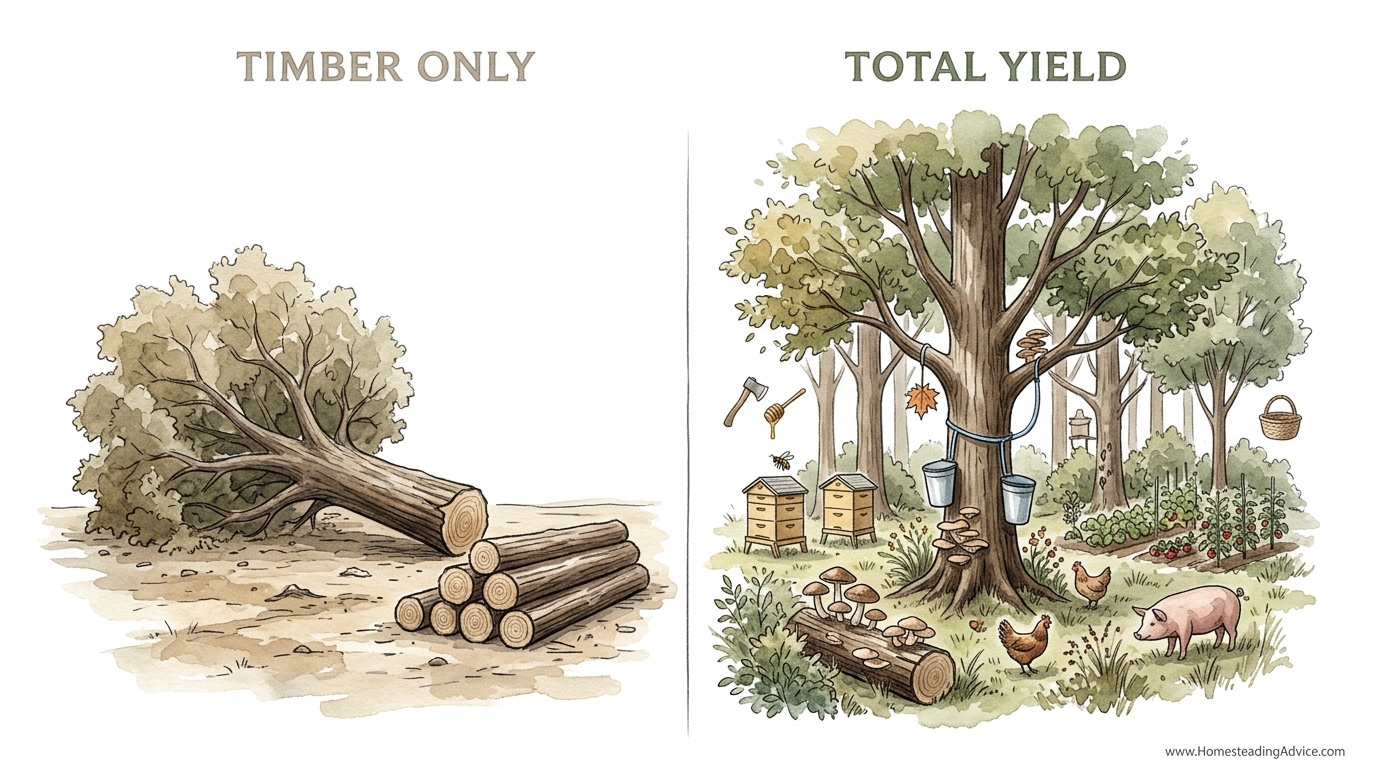
Why wait 30 years for a single timber paycheck when your woods can pay you every single season? If you only see your woods as a source of logs, you’re leaving 80% of the potential value on the ground. From gourmet mushrooms and medicinal gold to liquid sugar and craft bark, your woodlot is a multi-layered factory waiting for a smart manager. Here is how to unlock the total yield.
Managing a woodlot is often taught as a long game of patience. Traditional forestry tells you to plant trees, thin them occasionally for firewood, and wait for the sawyer to arrive three decades later. This extraction-heavy mindset ignores the vibrant, living ecosystem that hums between the roots and the canopy every day of the year.
True stewardship means looking at the vertical stacks of value. A single acre (0.4 hectares) of hardwood forest can produce a dozen different “crops” without ever compromising the health of the timber. You are shifting from being a simple tree farmer to becoming a forest manager who understands the rhythms of the seasons and the needs of the marketplace.
Multi-Use Woodlot Management For Profit
Multi-use woodlot management is the practice of cultivating multiple revenue streams from a single parcel of forested land. It moves beyond the “timber only” model, which treats the forest as a single-crop field, and instead embraces the forest as a diverse ecosystem. This approach is rooted in the idea of total yield, where every layer of the forest—from the deep roots to the high branches—contributes to the homestead’s bottom line.
In the real world, this looks like a woodlot that produces high-value medicinal roots on the forest floor, gourmet mushrooms on low-value “weed” trees, and artisan syrup from the sap of the standing timber. This strategy provides annual cash flow, which is the missing piece for most small-scale forest owners. It turns the woods from a dormant asset into an active participant in your livelihood.
Think of your woodlot like a multi-story factory. The “basement” is your root zone for medicinals. The “main floor” is for understory crops and fungal production. The “walls” are the standing timber, and the “plumbing” is the sap flowing through the xylem. Managing for total yield means keeping all these systems running at peak efficiency simultaneously.
The Philosophy of Total Yield
Transitioning to a total yield model requires a change in perspective. You must stop seeing “cull trees” as waste and start seeing them as the substrate for a thousand pounds of mushrooms. You must stop seeing shade as a hindrance and start seeing it as the essential environment for wild-simulated ginseng. Every limitation in traditional farming becomes an opportunity in forest management.
This approach also builds ecological resilience. When you manage for multiple products, you naturally encourage a diversity of species. This diversity protects your investment against pests, diseases, and market fluctuations. If the price of sawlogs drops, your mushroom harvest and syrup sales can carry the weight of the season.
The Liquid Harvest: Syrups Beyond the Sugar Bush
Maple syrup is the most famous forest product, but it is far from the only sweet secret hidden in the sap. If you have hardwoods on your land, you likely have the potential for a “liquid harvest.” While sugar maples (Acer saccharum) are the gold standard with a sugar concentration (Brix) of about 2%, many other species offer unique, high-value syrups that are becoming favorites in the craft food market.
Black Walnut (Juglans nigra) trees produce a sap that can be boiled down into a rich, nutty syrup. The sap-to-syrup ratio is similar to maple at roughly 40:1, meaning you need 40 gallons (151 liters) of sap to make one gallon (3.8 liters) of syrup. The flavor is intense and commands a premium price, often double that of traditional maple syrup. Tapping walnut trees is a fantastic way to generate income from trees that are still decades away from their timber prime.
Birch trees (Betula spp.) offer another opportunity, though they require a bit more grit. The sap flow for birch starts just as the maple season is ending, effectively doubling your harvest window. However, birch sap has a much lower sugar content, often requiring a 100:1 ratio. This means you will be boiling much longer, but the result is a savory, mineral-rich syrup that chefs use for glazes and dressings. It is a niche product with very little competition.
Mastering the Tap
Successful tapping requires understanding the “freeze-thaw” cycle. Sap flows when daytime temperatures rise above freezing (32°F / 0°C) and nighttime temperatures drop back below it. Use a 5/16-inch (8 mm) drill bit to minimize damage to the tree. Only tap trees that are at least 10 to 12 inches (25–30 cm) in diameter at breast height. A single healthy tree of this size can safely support one tap, while trees over 18 inches (45 cm) can support two.
Keep your equipment scrupulously clean. Bacteria is the enemy of high-quality syrup. Use food-grade buckets or tubing and boil the sap as soon as possible after collection. If sap sits in the sun for too long, it will begin to ferment, ruining the flavor of your finished product. For the best clarity, use a felt filter or a filter press once the syrup reaches the finished Brix level—usually 66 to 67% sugar.
The Fungal Floor: Managing Mushrooms for Annual Income
If you are thinning your woodlot to improve timber quality, you are sitting on a goldmine of mushroom logs. Shiitake (Lentinula edodes), Oyster (Pleurotus spp.), and Lion’s Mane (Hericium erinaceus) can all be grown on logs that are otherwise too small or crooked for the sawmill. These “cull logs” are the perfect medium for fungal cultivation.
Log-grown shiitakes are the most reliable forest crop for beginners. They prefer oak, but will grow on most hardwoods like beech, birch, and sugar maple. The process involves drilling holes in a diamond pattern every 6 inches (15 cm) along the log and tapping in mushroom “plugs” or sawdust spawn. Sealing the holes with food-grade cheese wax protects the mycelium from drying out and keeps wild fungi at bay.
A single 4-foot (1.2 m) log can produce mushrooms for 3 to 5 years, depending on its diameter. Research shows that a well-managed operation of 500 logs can net upwards of $9,000 over a five-year period. Since the work is front-loaded—the inoculation happens once—the following years are mostly about harvesting and marketing. This is a high-margin product that fits perfectly into the pockets of time available to a busy land manager.
Optimizing the Laying Yard
The “laying yard” is where your inoculated logs will live. It must be shaded (70–80% shade) and have access to water. Stacking the logs in a “crib” or “lean-to” style allows for good airflow while keeping the logs off the bare soil to prevent contamination. If the weather is dry, you must soak the logs (called “shocking”) for 12 to 24 hours to trigger a fruiting flush. This ability to “fruit on demand” is what makes shiitakes a professional-grade crop; you can time your harvest for the Friday farmers market every week.
Watch out for the moisture content of your logs. If they drop below 25-30% moisture, the mycelium will die. If they stay too wet, they may rot before they fruit. Aim for a “sweet spot” of around 40-45% moisture. A simple way to check is to weigh a few sample logs at inoculation and track their weight over the season; a lighter log is a thirstier log.
The Understory Economy: Cultivating Wild Medicinals
The forest floor is the most undervalued “real estate” in the woodlot. If you have a north-facing slope with deep, well-drained soil and a healthy canopy of hardwoods, you have the potential to grow “medicinal gold.” American Ginseng (Panax quinquefolius) is the heavy hitter here, with “wild-simulated” roots fetching between $300 and $600 per dried pound (0.45 kg).
Wild-simulated cultivation is a low-input, high-patience method. Instead of clearing the land and using fertilizers (which produces “field-grown” roots that buyers find inferior), you simply plant the seeds in the natural leaf mulch of the forest. You do not till the soil; you do not spray pesticides. You let the forest grow the root exactly as it would in the wild. This preserves the “man-shaped” and wrinkled appearance that premium buyers demand.
Ginseng takes 7 to 10 years to reach a marketable size, making it a long-term investment. However, while you wait, you can harvest annual crops like Ramps (Allium tricoccum). Ramps are wild leeks that are highly sought after by high-end restaurants in the spring. They can be harvested sustainably by taking only 10% of the patch each year, providing immediate cash flow while the ginseng matures beneath them.
Protecting Your Botanical Investment
The biggest challenge with medicinal roots is not the biology—it is the security. Poaching is a real threat for high-value crops like ginseng. Many successful forest farmers keep their planting locations confidential and use trail cameras for security. It is also vital to check your local and state regulations; in many regions, you must certify your ginseng beds with the Department of Natural Resources to legally sell the roots.
Other botanicals like Goldenseal (Hydrastis canadensis) and Black Cohosh (Actaea racemosa) are excellent companions for ginseng. They require similar conditions and can be harvested in a shorter timeframe (3 to 5 years). By diversifying your understory planting, you ensure that even if one crop has a bad year, the others can fill the gap. Goldenseal, in particular, is valued for both its roots and its leaves, offering two different harvest windows.
Specialty Timber and the Craft Wood Market
Not every tree needs to be a 16-foot (5 m) sawlog to be valuable. In fact, some of the most profitable wood products come from the “imperfections” of the forest. Burls, figured grain, and even the bark of certain species can be sold to artisans and woodworkers for a price far exceeding their value as firewood or pulp.
Burls are abnormal growths on the trunk or branches where the grain has become twisted and knotted. To a traditional logger, a burl is a defect. To a woodturner, it is a treasure. A single large maple or walnut burl can be sliced into “bowl blanks” that sell for $50 to $100 each. If you have a tree with a massive burl, that one growth might be worth more than the rest of the tree combined.
Consider also the market for “character wood.” Spalted wood—lumber that has been partially decayed by fungi to create black, swirling lines—is highly prized for furniture and decorative items. By intentionally managing the decay of certain logs under controlled conditions, you can create a value-added product from wood that most people would throw away. This is the essence of multi-use management: finding the beauty and profit in the “waste.”
The Yield of Bark and Branches
Don’t overlook the outer layers. Eastern White Cedar (Thuja occidentalis) and Birch bark are used in traditional crafts and high-end interior design. Birch bark can be harvested from recently felled trees and sold in sheets to makers of baskets and canoes. Cedar boughs are a staple of the floral and greenery industry, especially during the winter months when other crops are dormant. Selling boughs from thinned cedar stands provides a quick return on labor with zero capital investment.
For those with a creative eye, “walking stick blanks” from saplings like Diamond Willow or striped maple can be a steady side-income. Straight, interesting saplings that need to be thinned anyway to give the “crop trees” room to grow can be harvested, dried, and sold to hobbyists. It is about capturing every ounce of value that the forest produces during its natural growth cycle.
Benefits of the Multi-Use Approach
The primary benefit of multi-use management is the dramatic increase in annual income. By stacking crops, you are no longer dependent on a harvest that happens once every few decades. This makes land ownership more sustainable for families who need to see a return on their investment to pay for taxes, equipment, and maintenance.
Beyond the financial gains, this method significantly improves forest health. By spending time in your woods tapping trees, checking mushroom logs, and monitoring medicinal patches, you become intimately familiar with your land. You will notice the first signs of pest infestations or disease much sooner than a hands-off owner would. Your thinnings are purposeful, removing the weak to favor the strong, while still putting food on the table.
Environmental benefits are also substantial. Forest farming and NTFP (Non-Timber Forest Product) cultivation keep the canopy intact. Unlike clear-cutting, these methods preserve the soil structure, protect water quality, and provide continuous habitat for wildlife. You are working with the ecology of the woods, not against it, which ensures that the land remains productive for the next generation.
Challenges and Common Mistakes
One of the most frequent mistakes is trying to do too much at once. A woodlot is a complex system, and each “crop” requires its own set of skills and timing. A beginner might try to start a 1,000-log mushroom yard, a 5-acre syrup operation, and a ginseng plantation all in the same year. This leads to burnout and neglected crops. Start with one system—perhaps the mushrooms—and master it before adding the next layer.
Another pitfall is ignoring the market before you plant. Growing 500 pounds (227 kg) of ramps is a great achievement, but if you don’t have a relationship with local chefs or a plan for cold storage, they will rot before you can sell them. Forest products are often perishable and seasonal. Success requires a marketing plan that is just as robust as your management plan. Talk to buyers early and understand their needs regarding quality, quantity, and packaging.
Underestimating the impact of wildlife is a hard lesson for many. Deer love ramps and goldenseal. Slugs can decimate a mushroom harvest overnight. Turkeys might scratch up your ginseng beds. Without proper fencing or management strategies, the local wildlife can harvest your profit before you do. Always factor in the cost and time of protection when planning your woodlot ventures.
Limitations and Constraints
Not every woodlot is suitable for every product. Soil pH, moisture levels, and aspect (the direction the slope faces) play a massive role in what will thrive. For example, trying to grow ginseng on a dry, south-facing pine slope is a recipe for failure. You must work within the constraints of your specific geography. A thorough site assessment, including soil testing and species inventory, is the first step of any smart manager.
Time is another realistic constraint. Multi-use management is labor-intensive. While it provides annual income, that income is earned through sweat equity. Tapping trees, hauling sap, inoculating logs, and weeding medicinal beds takes hours of physical work. If you are a weekend owner who only visits the land once a month, many of these systems will fail. These are “active” crops that require a consistent presence.
Market access can also be a boundary. If you live in a remote area far from urban centers, selling fresh gourmet mushrooms or delicate ramps can be difficult. You may need to focus on products that can be dried, processed, or shipped easily, such as dried medicinal roots, syrups, or specialty timber blanks. The logistics of your location should dictate your product mix.
Comparing Management Models
To help visualize the difference in approach, consider the following comparison between a standard timber-focused woodlot and a total yield managed woodlot.
| Feature | Timber Only Model | Total Yield Model |
|---|---|---|
| Income Frequency | Every 20–30 years | Annual / Seasonal |
| Labor Intensity | Low (contracted) | High (owner-operated) |
| Risk Distribution | High (single crop) | Low (diversified) |
| Ecological Impact | Periodic disruption | Continuous stewardship |
| Primary Value | Board feet of lumber | Ecosystem services & products |
Practical Tips for the Forest Manager
Keep a detailed “Woodlot Ledger.” Record the dates of your sap flows, the timing of mushroom flushes, and the growth rates of your medicinal patches. Over the years, this data becomes your most valuable tool, allowing you to predict harvests and plan your labor more efficiently. Ancestral wisdom is just data passed down through generations; start building your own today.
Invest in high-quality tools from the start. A professional-grade drill for mushroom logs, a high-efficiency evaporator for syrup, and a sharp, well-balanced root spade will save you hundreds of hours of frustration. In the “pioneer-grit” mindset, a tool is an extension of your hand; buy the one that will last a lifetime.
- Soil Temperature: Use a soil thermometer in the spring. Ramps and ginseng respond to soil warming, not air warming. Knowing the exact temperature (usually 45–50°F / 7–10°C) tells you exactly when to start looking for the first greens.
- Log Selection: For mushrooms, cut your logs during the dormant season (late winter). This is when the sugar content in the wood is highest and the bark is most tightly attached, which is crucial for the longevity of the log.
- Thinning Strategy: When thinning for timber, mark your “crop trees” first. Then, look at the trees you are removing. Are they suitable for mushroom logs? Do they have interesting burls? Are they syrup species? Extract value from the “waste” before it ever hits the firewood pile.
- Water Management: If you are serious about mushrooms or medicinals, consider a gravity-fed irrigation system using a pond or spring from higher up the slope. Even a small amount of supplemental water during a summer drought can save a decade’s worth of ginseng investment.
Advanced Considerations for Scaling Up
For those who want to move beyond a hobby and into a serious business, efficiency is the name of the game. Consider “value-added” processing on-site. Instead of selling raw shiitakes, could you dry them and sell them as a gourmet pantry staple? Instead of selling raw sap, could you bottle high-end birch water? Processing your products increases their shelf life and your profit margin.
Collaborating with neighbors can also unlock new levels of scale. If you and three neighbors all manage 10-acre (4-hectare) woodlots, you can share the cost of expensive equipment like a professional syrup reverse-osmosis (RO) machine or a small-scale sawmill. By pooling your harvests, you can also approach larger buyers who require a consistent volume that a single small woodlot cannot provide.
Think about the “legal timber” of the future. Carbon credits and conservation easements are becoming viable ways for woodlot owners to be paid for the ecosystem services their land provides. By managing your woods for high diversity and long-term health (total yield), you are perfectly positioned to take advantage of these emerging markets. You are being paid to keep the forest as a forest.
Example Scenario: The 10-Acre Working Woods
Consider a 10-acre (4-hectare) woodlot in the temperate hardwoods. The owner decides to implement a total yield strategy. They identify 2 acres (0.8 hectares) of north-facing slope for wild-simulated ginseng and goldenseal. They plant $500 worth of seed. In year 8, they begin harvesting 10 pounds (4.5 kg) of dried ginseng annually, netting roughly $5,000 per year from just those two acres.
In the remaining 8 acres, they manage a 500-log shiitake yard. They spend their winters thinning out low-quality beech and ironwood to use as logs. This thinning improves the growth rate of their high-value red oaks. The shiitakes provide a weekly harvest from June through September, selling at $15 per pound ($33/kg) at the local market, bringing in another $3,000 per season.
They also tap 50 black walnut trees scattered throughout the property. This produces about 10 gallons (38 liters) of walnut syrup, which they sell to a local high-end restaurant for $120 per gallon. Total annual income from these three products alone reaches nearly $10,000, all while the primary timber (the red oaks) continues to put on diameter and value for a future generation. This is the power of the multi-use woodlot.
Final Thoughts
Unlocking the total yield of your woodlot is about more than just money. It is about reviving the ancestral connection between the person and the land. It is about understanding that a forest is not a static object to be looked at, but a dynamic partner to be worked with. When you manage for mushrooms, syrups, and medicinals, you are participating in the full cycle of life.
The transition requires grit and a willingness to learn. You will make mistakes—a batch of syrup will scorch, or a deer will find your best ramp patch—but each mistake is a lesson in forest literacy. Over time, you will develop an eye that sees value where others see brush, and a hand that knows exactly when the sap is ready to run.
Start small, stay observant, and don’t be afraid to get your hands in the dirt. Your woods have been waiting for a manager who sees their true potential. By shifting your focus from “timber only” to “total yield,” you ensure that your land remains a productive, profitable, and beautiful legacy for years to come. The woods are ready to pay you—it’s time to start the harvest.